The Woman Who Knows Where Everyone Is Buried: A Week Inside Our Genealogy Room
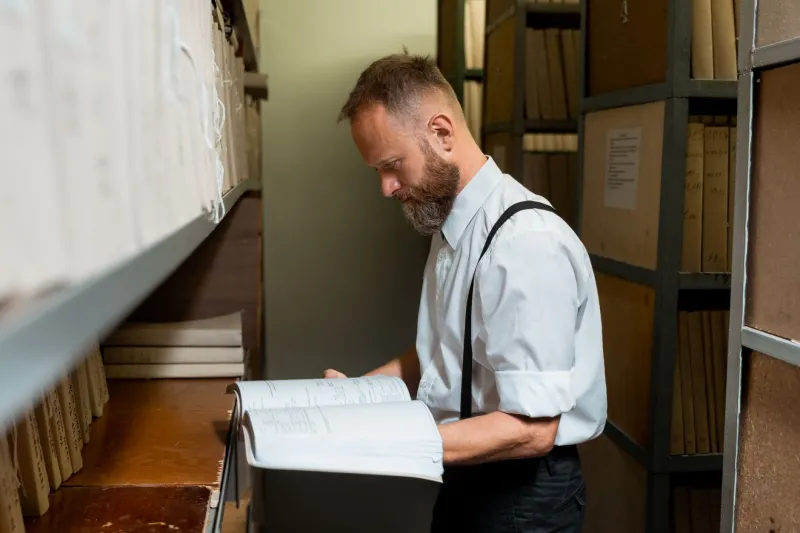
There's a room in the basement of Luverne Public Library where the Wi-Fi signal is weak, the fluorescent lights hum like cicadas, and nobody under 25 ever wanders in by accident. It's the genealogy room, and if you've never been down there, you're sitting on a family story you don't know yet.
We spent a week shadowing Doris Albrecht, the library's archivist and, by her own cheerful admission, "the woman who knows where everyone in Rock County is buried." Here's what we learned.
Monday: The Census Reel and the Man From Arizona
A retired trucker named Gary drove in from out of state with nothing but a first name, a guess about a birth year, and a story his mother told him before she passed. By lunch, Doris had him elbow-deep in census microfilm, scrolling through handwritten farm schedules from 1910.
"People think genealogy is typing a name into a website," Doris says. "It's really squinting at a census taker's terrible handwriting and realizing your great-grandfather told the government he was two years younger than he was. Everybody lied about something. That's how you know it's them."
The library keeps microfilm reels of the federal census for the whole region, plus state censuses that fill in the gaps between the big federal counts. When Gary found his family listed between two neighbors he recognized from local road names, he got quiet for a second. That happens a lot down here.
Tuesday: The Obituary Files, Alphabetized by Gossip
The genealogy room's most-used resource isn't digital at all. It's a wall of file cabinets stuffed with obituary clippings from local papers, going back over a century, organized by surname.
These clippings are gold. A good obituary names parents, siblings, church affiliations, the cemetery plot, and often the cause of death — which is how one visitor this week discovered her great-grandfather was struck by lightning in 1923 and lived to tell about it in the newspaper twice.
Doris's tip: don't stop at your direct ancestor. "Read the whole obituary. The pallbearers are usually brothers-in-law. The 'beloved niece from Sioux Falls' is usually your missing branch."
Wednesday: The One-Room Schoolhouse Photographs
The room's photo collection includes class pictures from a dozen rural schools that closed decades ago — buildings that are now grain bins, houses, or bare fields. The photos are labeled in pencil on the back, sometimes with every student's name, sometimes with a helpful note like "teacher's dog."
One visitor came in specifically because her late mother mentioned attending a school called Oak Grove No. 4. Doris pulled the photo in about four minutes. There was her mother, second row, missing a front tooth, age eight.
Copies of most photos can be made for a small fee, or you can photograph them yourself with your phone. Staff just ask that you skip the flash around the older prints.
Thursday: How to Start Your Own Search (For Free)
Everything in the genealogy room is free to use with a library card, and Doris walked us through her recommended starting sequence:
- Write down what you already know. Names, approximate dates, places. Start with yourself and work backward. Never start with the immigrant ancestor — that's the fastest way to research the wrong family for six months.
- Talk to the oldest relative you have. Record it if they'll let you. Names of siblings, churches, cemeteries, and "the farm outside of town" are all clues.
- Check the census. Federal census records every ten years are the backbone of American family research. Ours are on microfilm and accessible through the library's free genealogy database subscriptions.
- Hit the local records. Obituaries, county histories, plat maps, marriage and cemetery indexes — the room has them, and much of it exists nowhere online.
- Ask Doris. Or whoever is staffing the desk that day. The reference help is free, and honestly, it's the best part of the service.
Friday: Why This Room Matters
By the end of the week, five different people had come through the door. A teenager working on a school project. A woman hunting her biological grandmother. A man who just wanted to know if the story about his great-uncle and the runaway horses was true. (It was. The newspaper confirmed it, with slightly more detail than the family preferred.)
"People think this stuff is for old folks," Doris says, restacking a shelf of plat maps. "But every family has somebody who wants to know. They just don't know the answer is sitting in a basement on a reel of film."
The genealogy room is open during all regular library hours, though it's worth calling ahead if you want one-on-one help with the microfilm readers or the scanners. Bring a pencil — pens near the old documents are strictly forbidden — and bring what you know.
Your grandparents left a paper trail. Somebody in this basement knows how to read it.